Continuous Glucose Monitor
PARTLY FROM THE NIH PAGE ( LINKED TO THE NIH PAGE)
What is continuous glucose monitoring?
How does a continuous glucose monitor (CGM) work?
Who can use a CGM?
What are the benefits of a CGM?
What are the limits of a CGM?
What is an artificial pancreas?
What is continuous glucose monitoring?
Continuous glucose monitoring automatically tracks blood glucose levels, also called blood sugar, throughout the day and night. You can see your glucose level anytime at a glance. You can also review how your glucose changes over a few hours or days to see trends. Seeing glucose levels in real time can help you make more informed decisions throughout the day about how to balance your food, physical activity, and medicines.
How does a continuous glucose monitor (CGM) work?
A CGM works through a tiny sensor inserted under your skin, usually on your belly or arm. The sensor measures your interstitial glucose level, which is the glucose found in the fluid between the cells. The sensor tests glucose every few minutes. A transmitter wirelessly sends the information to a monitor.
The monitor may be part of an insulin pump or a separate device, which you might carry in a pocket or purse. Some CGMs send information directly to a smartphone or tablet. Several models are available and are listed in the American Diabetes Association’s product guide External link.
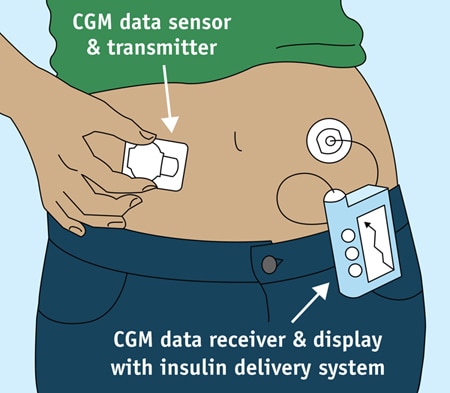
Special Features of a CGM
CGMs are always on and recording glucose levels—whether you’re showering, working, exercising, or sleeping. Many CGMs have special features that work with information from your glucose readings:
An alarm can sound when your glucose level goes too low or too high.
You can note your meals, physical activity, and medicines in a CGM device, too, alongside your glucose levels.
You can download data to a computer or smart device to more easily see your glucose trends.
Some models can send information right away to a second person’s smartphone—perhaps a parent, partner, or caregiver. For example, if a child’s glucose drops dangerously low overnight, the CGM could be set to wake a parent in the next room.
Currently, many CGM model is approved for treatment decisions, the Dexcom . That means you can make changes to your diabetes care plan based on CGM results alone. With other models, you must first confirm a CGM reading with a finger-stick blood glucose test before you take insulin or treat hypoglycemia.
Special Requirements Needed to Use a CGM
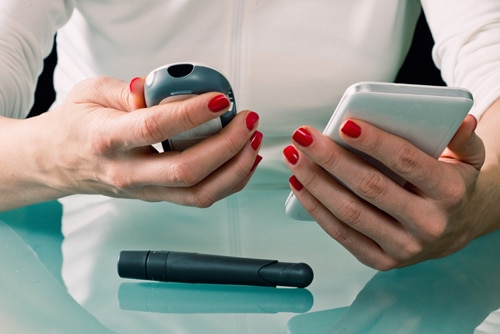
You may need to check the CGM itself. You’ll test a drop of blood on a standard glucose meter. The glucose reading should be similar on both devices.
You’ll also need to replace the CGM sensor every 7 to 14 days, depending on the model.
For safety it’s important to take action when a CGM alarm sounds about high or low blood glucose. You should follow your treatment plan to bring your glucose into the target range, or get hel
 A KSHAMICAMD WEBSITE